
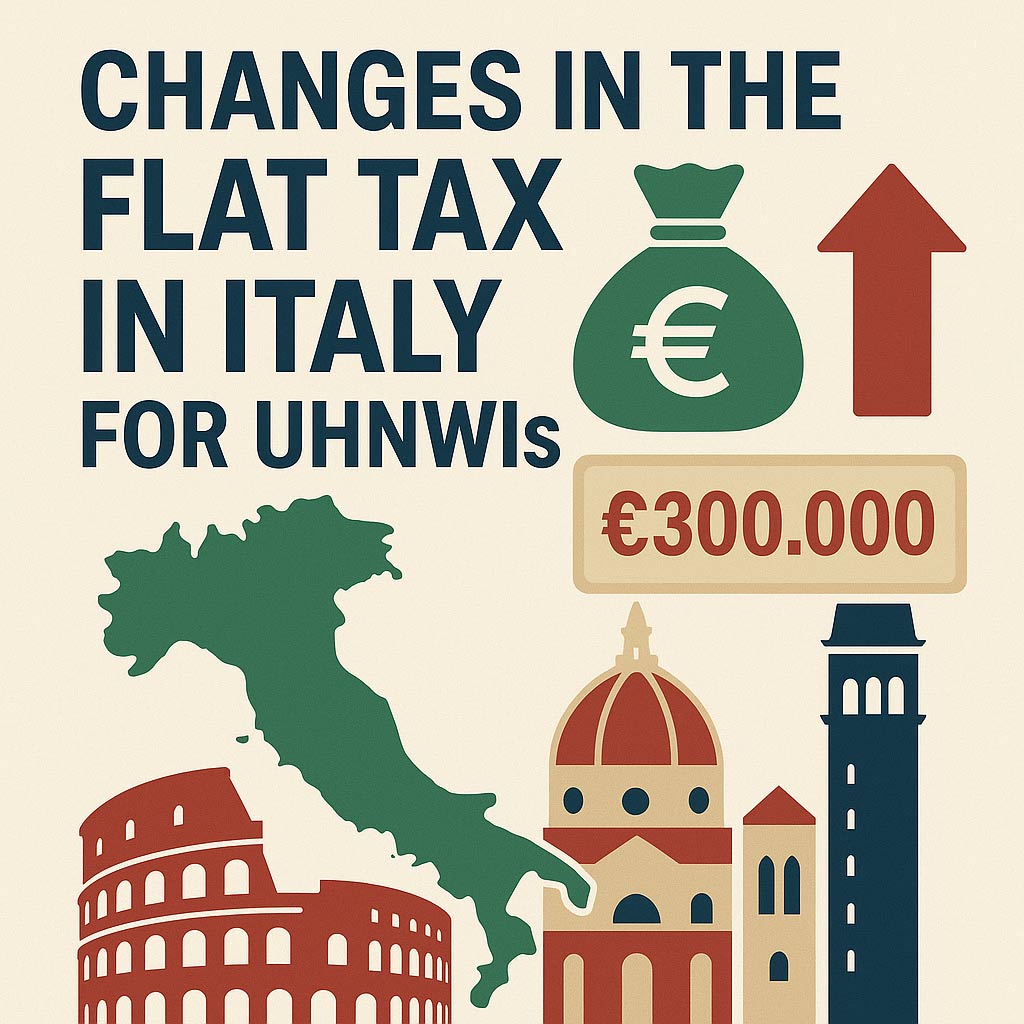
Italy’s Flat Tax regime has been one of the most attractive incentives in Europe for Ultra High Net Worth Individuals considering a relocation. With the 2026 Budget Law, the italian government has introduced a new adjustment that raises the annual substitute tax from Euro 200.000 to Euro 300.000 for the main taxpayer and from Euro 25.000 to Euro 50.000 for each eligible family member.
Yet, despite the headline increase, the core appeal of the regime and Italy’s broader advantages for UHNWIs remain solid and unchanged.
Who is protected from the Flat Tax increase
The new thresholds apply only to individuals who will establish their civil residence in Italy from 1 January 2026 onwards.
Those who take up residence by 31 December 2025 will continue to benefit from the current rates of Euro 200.000 for the main taxpayer and Euro 25.000 for each family member.
How the Flat Tax regime works
Introduced in 2017, the regime under Article 24-bis of the Italian Income Tax Code allows new residents to replace ordinary taxation on foreign-source income with a fixed annual payment, irrespective of the amount of worldwide income generated.
Key conditions and features include:
• The taxpayer must not have been fiscally resident in Italy for at least nine of the previous ten tax years.
• Foreign-source income is covered by the flat tax, while Italian-source income remains subject to ordinary taxation.
• The regime lasts 15 tax years and can be voluntarily revoked at any time.
• The option can be extended to qualifying family members, currently for Euro 25.000 each, rising to Euro 50.000 from 2026.
Additional benefits of the Flat Tax
Beyond fixed taxation of foreign income, the regime offers substantial advantages, especially relevant to UHNWIs:
• Exemption from IVIE, IVAFE (taxes on the value of properties and financial assets located abroad) and from the tax on crypto-assets
• No requirement to report foreign assets under fiscal monitoring rules
• Exemption from inheritance and gift tax on assets held abroad
The last point, in particular, continues to be a decisive reason why many international families choose Italy as their long-term base.
Why this increase will not reduce Italy’s attractiveness
Although the rise to Euro 300.000 may seem significant, in practice it is unlikely to deter UHNWIs.
The amount remains competitive compared to similar regimes in Europe, and – crucially – the underlying structural advantages of living in Italy remain unchanged. The inheritance and gift tax exemption for foreign assets alone often far outweighs the increase, and the country continues to offer unique lifestyle, cultural, and strategic benefits that few jurisdictions can match.
The unique appeal of the Italian Riviera
For many relocating families, the decision goes far beyond taxation. The Italian Riviera, especially the western stretch between San Remo, Ospedaletti, Bordighera and Alassio, continues to attract discerning international buyers for reasons that remain unaltered:
• Safety and quality of life, ideal for long-term residence
• Proximity to Monaco and the Côte d’Azur, with the ability to enjoy both Italian and French charm
• Excellent accessibility, thanks to Nice International Airport only a short drive away
• A mild climate and year-round lifestyle, without the seasonality typical of many Mediterranean regions
• Cultural richness, gastronomy, outdoor life and an authentic local community
• Outstanding property opportunities, from historic villas to modern seafront apartments
These factors combined ensure that Italy, and in particular the Italian Riviera, remains a highly competitive destination for UHNWIs looking for a permanent home in Europe, even under the revised Flat Tax regime.
For those considering relocation or evaluating real estate opportunities in West Liguria, our team at LiguriaHomes Casamare & Hamptons is available to advise on the best residential solutions along this exceptional stretch of coastline.
Matteo Scandolera
