
A stone‑built cultural sanctuary on Via Romana
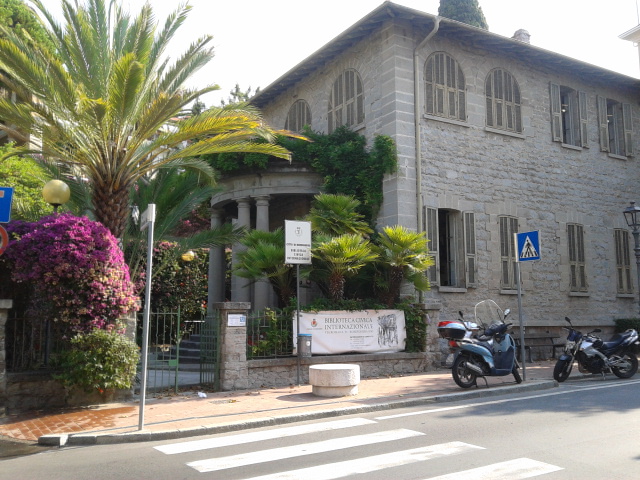
When walking along Via Romana in Bordighera it is impossible not to be captivated by the understated elegance of the International Civic Library. The building was designed in the early twentieth century when the local British community decided that the modest reading room in the Anglican church could no longer contain their growing collection. Funds were raised to erect a more suitable home, and in 1910 a two‑storey library in Victorian stone was completed. Its façade is graced by a semi‑circular portico supported by six columns and softened by a century‑old wisteria. Even today the scent of the flowering vine wafts across the library’s garden each April, an unforgettable introduction to one of the Mediterranean’s finest public libraries.
An outgrowth of Britain’s long love of reading
The establishment of Bordighera’s library says much about the literary culture of its founders. Eighteenth‑century Britain produced the modern novel; authors such as Daniel Defoe and his Robinson Crusoe, Henry Fielding (Tom Jones), and Laurence Sterne (Tristram Shandy) not only defined a new literary form but also encouraged reading among the middle classes. To meet this growing appetite for books, circulating libraries became popular in Britain and, when English families began wintering on the Ligurian coast, they brought the idea with them. The first reading room in Bordighera opened in about 1880 in the Anglican church. As the collection expanded it moved to Clarence Bicknell’s museum and then, thanks to local donations, to the purpose‑built library we see today.
Growth, generosity and wartime disruption
The early holdings of Bordighera’s library centred on English‑language novels and scientific works, especially books on botany and geography that related to the Ligurian Riviera. Over time volunteers and paid subscribers funded new acquisitions. One of the most generous benefactors was Queen Margherita of Savoy, who enjoyed staying in Bordighera’s mild climate and left sizeable donations to the library. By the eve of the First World War the collection was flourishing. The Second World War, however, brought turmoil: the United Kingdom and Italy were on opposing sides, and most British residents left, shuttering their villas. Before returning home Mrs Margaret Berry entrusted the library and the adjacent Bicknell Museum to the newly formed Società Ingauna e Intemelia, which later became the International Institute of Ligurian Studies. In 1943 the municipality learned that the Institute planned to transfer the books to Turin; to prevent the loss the city took over the library free of charge.
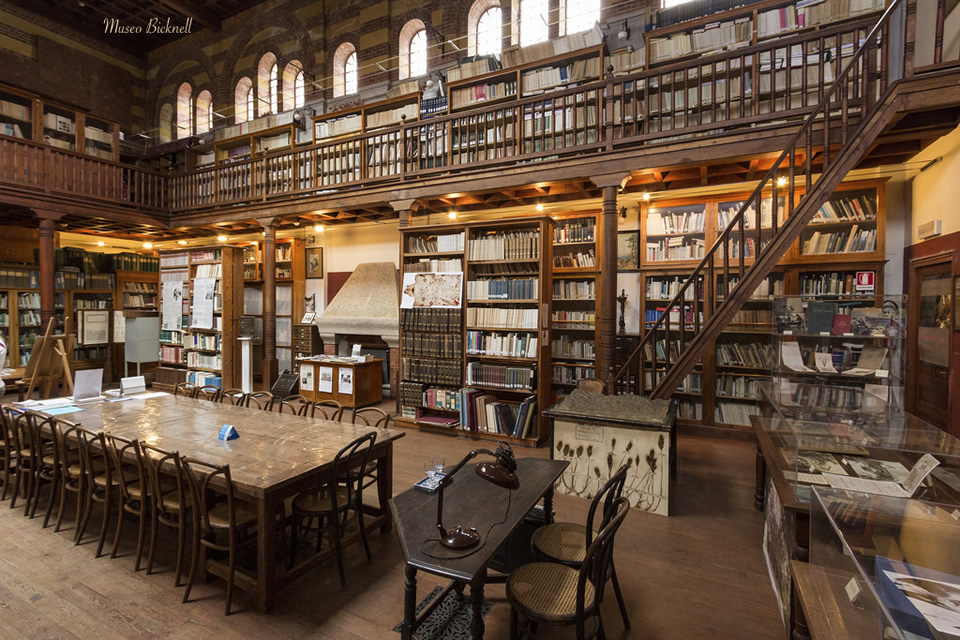
World War II left both the building and the collection in need of attention. The library reopened briefly in 1944, only to close again when Bordighera was bombed. After the conflict ended volunteers patiently repaired and rebound the damaged volumes and the readers slowly returned. During this period the library expanded beyond its Anglo‑Italian core; books in French and German were joined by works in Spanish, Portuguese, Dutch, Polish, Swedish, Norwegian, Slovak and Russian. Today the holdings exceed 80 000 volumes and include many periodicals and nearly a thousand digitised photographs of Victorian Bordighera.
Renovation and the modern open‑shelf library
In 1985 the municipality commissioned Gianfranco Franchini, a Genoese architect best known for collaborating with Renzo Piano on Paris’s Centre Pompidou, to renovate and enlarge the library Franchini respected the external Victorian appearance, extending the facilities and bringing the upper floor into use. Inside, the library adopted an open‑shelf system: visitors can wander freely among the stacks, though some special collections remain in closed reserves. According to the municipality, the modern library houses around 50,000 books in Italian, 20,000 in English, 7,000 in French and 3,000 in German, along with numerous periodicals and 950 historic photographs. Books are catalogued according to Dewey and Reicat classification schemes.
Visiting the library today
The International Civic Library is no longer an exclusive British enclave but a public institution open to anyone with a passion for books. Membership is free; visitors simply register at the information desk. The library offers local loans, inter‑library loans and document delivery services, as well as bibliographic assistance and guided tours. First‑time borrowers might choose Il Dottor Antonio by Giovanni Ruffini, the novel that first introduced Bordighera and the Riviera dei Fiori to English travellers in the nineteenth century. Beyond its shelves, the building itself deserves careful appreciation; the wisteria‑draped portico and verdant garden evoke the charm of the Edwardian era while the bright, modern reading rooms speak to the city’s commitment to preserving its cultural heritage.
A treasure for residents and newcomers alike
The story of Bordighera’s International Civic Library illustrates how a community of expatriates left an enduring legacy in western Liguria. From a small reading room in the Anglican church to a prominent public institution, the library has weathered wars and political upheavals while continuing to serve readers of many nationalities. For those thinking of making the Riviera dei Fiori their home, the library is an emblem of the area’s cosmopolitan spirit and cultural richness. At LiguriaHomes Casamare & Hamptons we believe that discovering a place involves more than viewing its villas and apartments; it means understanding its history, traditions and institutions. When you visit Bordighera, set aside an afternoon to explore the International Civic Library. To learn more about living in this remarkable corner of Liguria browse our properties on our website.
To fully appreciate Bordighera’s Anglo‑Liguran heritage, why not speak with a team who live and breathe it? Our LiguriaHomes Casamare & Hamptons office in Bordighera works hand in hand with the renowned Hamptons network in England, offering insight and assistance to international clients seeking a home on the Riviera dei Fiori. We invite you to visit us in person or write to info@liguriahomes.com to learn how we can help you become part of this rich, cross‑cultural story.
