
Italian Market Overview

Italy’s residential market has turned a corner with viewings, prices and sales all increasing in 2015.  Confidence is returning to the market but accurate pricing and realistic wish lists are a must for vendors and buyers.
Italy Report by Knight Frank

Prices
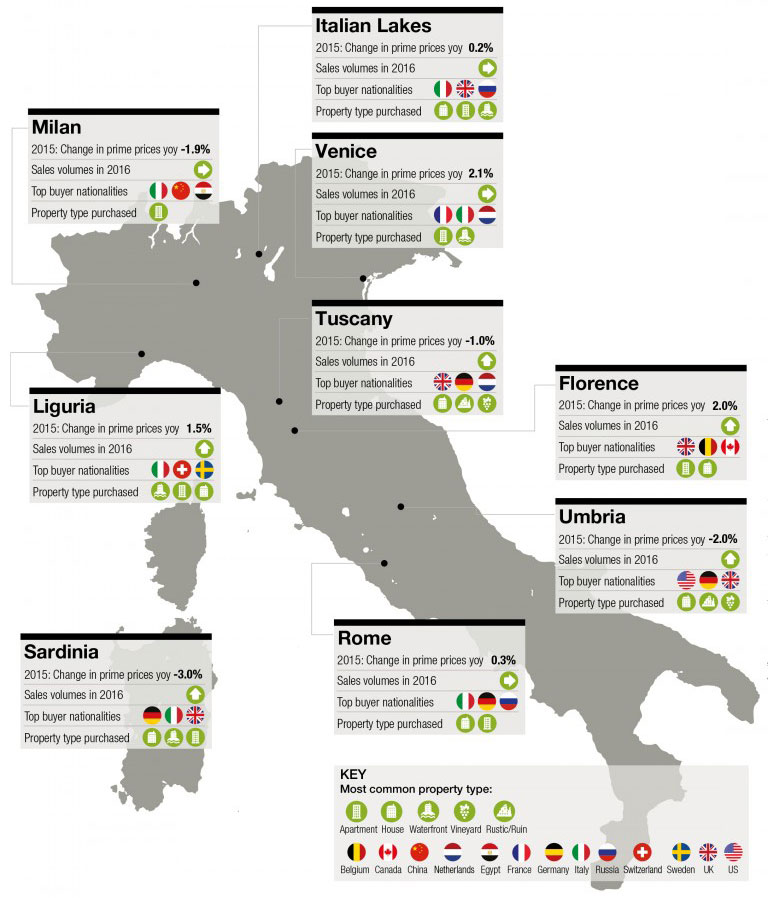
According to the Italian Statistics Office, 2015 marked a turning point for residential prices with price growth re-entering positive territory. Prime prices, having softened for several years, are following a similar trend. Across Knight Frank’s nine prime second-home markets, price performance has converged with annual growth ranging from 2.1% (Venice) to -3% (Sardinia) in 2015.
Although double digit annual price falls are firmly in the past we do not expect luxury prices to increase rapidly. Accurate, sensible pricing by vendors remains critical, particularly given the volume of properties available.

Sales
Market confidence is strengthening, residential sales increased by 7% in 2015 and Italy’s consumer confidence index is up 39% since its low in 2012. With properties now competitively priced and the choice of properties at its best for several years those buyers with access to cheap finance and those foreign buyers, able to take advantage of the favourable exchange rate, are deciding to act.
In 2016 we expect sales activity to strengthen in five of our prime markets (Tuscany, Florence, Umbria, Liguria and Sardinia) and to stay broadly stable in the remaining four.

Demand
In 2015 enquiries from buyers looking for an Italian property jumped 57% year-on-year. Tuscany continues to generate the most interest but Liguria and the Italian Lakes (from Como to Maggiore) are increasingly on buyers’ radar.
Italy attracts interest on a global scale. In 2015, some 171 nationalities searched for Italian properties on Knight Frank’s website with British, Italian, US and German buyers remaining the most active in the prime segment.
Buyers look to be taking advantage of current stock levels. The average number of property viewings undertaken per buyer rose from 2.1 in 2014 to 2.5 in 2015.

Currency
In the last two years, the euro has slipped from 0.83 to 0.73 against the pound and from 1.38 to 1.09 against the dollar providing British and US buyers with a strong buying opportunity in Italy.
Taking account of currency movements only this means a British buyer purchasing a €1m property will have seen a 12% reduction in price (or £98,000 in real terms) whilst a US buyer would have seen a saving of 21% (or $288,000). With QE stimulus still in place across the Eurozone and the dollar likely to strengthen in 2016 on the back of the Federal Reserve’s rate rise we expect foreign buyers to continue to benefit
during 2016.

To download the complete Report please click here: “Inside View” by Knight Frank


The Permesso di soggiorno

As explained below, the main advantage of being resident in Italy is that registration tax to be pais on completion is lower.

Since 1st January 2007, the permesso di soggiorno no longer applies to European Union nationals living in Italy. However, British nationals must take out a residence certificate at the Ufficio Anagrafe. After having submitted the application, the local Polizia Municipale will come and check where you live, so it may take some time before the certificate is ready.

The day you are resident in Italy, you have the same rights as an Italian to the National Health Service. Pensioners from EU countries will need form E121, while EU nationals transferred to Italy by their home country will need forms E101 and E111. E300 is used for anything regarding unemployment benefits.

From: The Italian Magazine – December 2007

The process of purchasing

Buying in Italy is similar to buying in the UK to the extent that there is an offer and acceptance procedure, which is usually followed by an exchange of contracts:  the Preliminary Act (“Compromesso”) and the final deed (“Atto/Rogito Notarile”) in front of an Italian Notary. The deed is signed and the balance of the purchase monies handed over in exchange for the keys. The contract is subsequently recorded in a Public/Land registry.

Things to know:

– Most Italian properties are freehold.

– Under Italian Law, there is no penalty fee if you pay the entire mortgage amount, before the original end.

– In Italy, since 1989, the Estate Agent (“Agente immobiliare”) must be registered in the register of estate agents held at the Chamber of Commerce, after he has passed an hard Examination on every aspects about property purchase process. LiguriaHomes director, Matteo Scandolera, is also an Official Property Consultant of the Sanremo Court.

Under Italian Law a property has a Legal or Tax value (“Valore Catastale”); this is a value placed on a property by the Government and is generally considerably less than the commercial price of the property (approx from 30 to 50% of the commercial price). It is the figure on which taxes are calculated as reported in the Local Land Registry Office (“Catasto”).

A step-by-step guide

– The first step is formalising the Offer to the vendor, through the estate agent as an intermediary. The offer is then placed in writing and you will normally have to pay a deposit on the property (5,000 – 10,000 EUR). If the offer is accepted, this deposit paid is defined as “Caparra Confirmatoria” and in the event either party withdraws from the sale the other party has the right to force the sale, and/or collect damages and/or have back the deposit (if the seller is the breaching party it can be twice the deposit amount).

– Once the seller accepts the offer, the parties have a binding contract, which is then formalised with the execution of the Preliminary Act (“Compromesso”), a formal agreement according to which the parties undertake to buy and sell the property and agree on the terms and conditions of the sale. On signing the “Compromesso”, the buyer pays normally the 10% deposit (“Caparra Confirmatoria”) on the purchase price. It is an important stage and it is necessary for you to understand the details of the contract. That is the reason why we prefer to appoint an english spoken Notary, for ensuring that everything is clear and that you understand all the terms and conditions. At this stage you have to pay the Commission Fee (“Provvigione”) to the estate agent.

– The transfer of the property takes place with the execution of a deed of sale rogito in front of a Notary. The Notary (“Notaio”) is the only professional entitled to transfer legal title to properties in Italy. Although the notary is  selected and paid by the buyer, he is an independent public officer/professional  charged with the duty of drafting the Purchase Deed finalizing the sale, ensuring that title passes legally between the parties, verifying the necessary legal documentation and registration in the Local Land Register.
 

FEES & TAXES

– Registration tax/stamp duty is paid, in a simplified term, on the governments valuation of the property, the “Valore catastale”. If you are buying the property as a holiday home, stamp duty will be 10% of this government valuation. If however you wish to move to Italy and apply for residency (“Prima casa”) within 18 months of the closure, then the stamp duty becomes 3% (4% in case of new construction). It is paid at the time of the sale, to the Notary.

– Two property taxes are levied in Italy: a Council tax, called “ICI”, which is paid to the local Comune (between 0.4% – 0.7% on the tax value) whether you are a resident or non-resident; and IRPEF (Physical Person Income Tax), which is paid to the state. The main residence is not subject to Irpef. Non-residents must submit a tax return stating the details of their Italian property, even though there’s no tax to pay.
– Just for holiday homes, if the owner sells prior to 5 years incurs a charge of 20% Capital Gain on the gain between the buying price and the selling price.
 

POST-COMPLETION FORMALITIES

– Once the purchase has been completed in the Notary’ office, the foreign buyer will mainly be interested in obtaining a certified copy of the Purchase Deed, as duly lodged with the authorities by the Italian Notary appointed. A copy of the Purchase Deed (“Rogito”) is usually available for collection within 2 – 3 months from the date of completion. Liguria Homes will collect it for you.

– Formal notice should be given to the local police authorities (Questura) of the purchase, by using a form usually supplied by the Notary and delivered by the estate Agent.

– Finally, it will be necessary to arrange for new contracts (“Volturazione delle utenze”) with the main utilities (power, water, gas, telephone, etc.). Liguria Homes will do it for you.

– Where the property is in a block of flats, to inform the condominium manager (“Amministratore del condominio) of the transfer of the flat to the foreign buyer.  Liguria homes will do it for you.

– Also, LiguriaHomes offers its rental division to rent out your property so you can obtain the best possible return on your investment, if you wish.